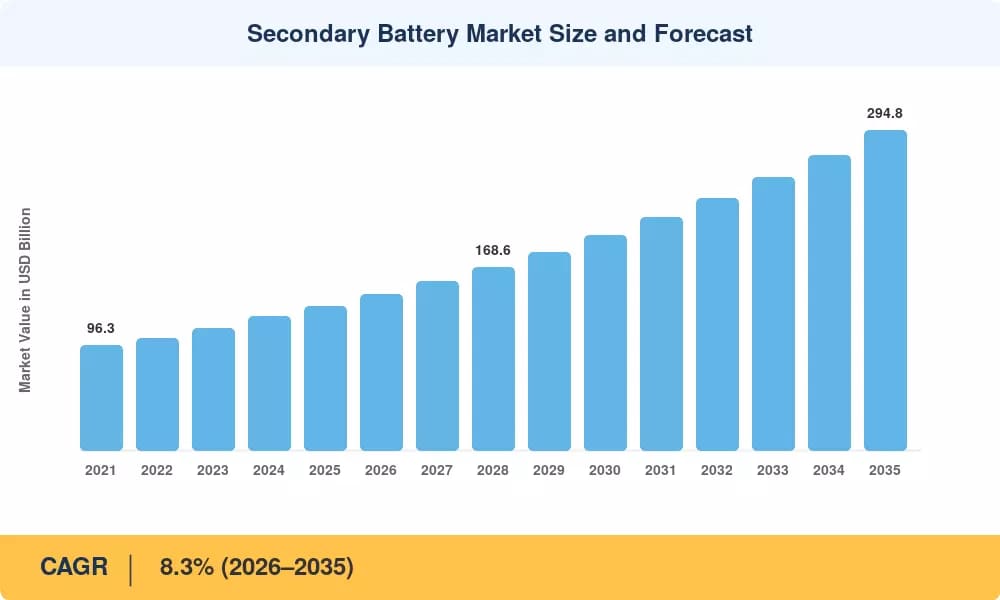
Secondary Battery Market to Reach USD 294.8 Billion by 2035, Growing at 8.3% CAGR
Each battery electric vehicle requires 50–100 kWh of cell capacity, translating EV unit growth directly into GWh

Press Release Disclaimer: This is a press release distributed through the XPR Media network. It has not been independently verified by our newsroom.

Each battery electric vehicle requires 50–100 kWh of cell capacity, translating EV unit growth directly into GWh pull-through for the Secondary Battery Market
NEW YORK, NY, UNITED STATES, July 29, 2026 /EINPresswire.com/ — The Secondary Battery Market reached an estimated USD 132.8 billion in 2025 and is projected to grow from USD 143.8 billion in 2026 to USD 294.8 billion by 2035, registering a CAGR of 8.3% during the 2026–2035 forecast period.
Market Overview
Secondary batteries industry, also known as rechargeable batteries or accumulators, are electrochemical energy storage devices that can be charged, discharged, and recharged multiple times through reversible chemical reactions. These batteries convert chemical energy into electrical energy during discharge and reverse the process during charging, enabling repeated use and extended service life. Secondary batteries are available in various chemistries including lithium-ion, lead-acid, nickel-cadmium, nickel-metal hydride, sodium-sulfur, and emerging technologies such as solid-state and sodium-ion batteries. Each chemistry offers distinct characteristics in terms of energy density, power density, cycle life, safety, and cost, making them suitable for different applications. Lithium-ion batteries dominate the market due to their high energy density, long cycle life, and declining costs. Secondary batteries are essential components in consumer electronics, electric vehicles, grid-scale energy storage, industrial applications, and backup power systems.
The Secondary Battery Industry is experiencing extraordinary growth driven by several key factors. The rapid global adoption of electric vehicles is a primary growth driver, creating massive demand for high-performance lithium-ion batteries. The increasing deployment of renewable energy sources and the need for grid-scale energy storage to manage intermittency are driving demand for utility-scale battery systems. The growing consumer electronics market, including smartphones, laptops, and wearables, continues to support demand for portable batteries. The declining costs of battery technology and improvements in energy density and cycle life are expanding application possibilities.
Key industry trends shaping the secondary battery market include the development of advanced battery chemistries, including solid-state batteries, lithium-sulfur batteries, and sodium-ion batteries, offering higher energy density and improved safety. The increasing focus on battery recycling and the development of circular supply chains for critical materials is gaining momentum. The adoption of lithium iron phosphate (LFP) batteries in electric vehicles and storage applications is growing due to cost advantages and safety benefits. The vertical integration of battery manufacturing, including cell production and pack assembly, is reshaping the competitive landscape.
The market is also benefiting from technological advancements in electrode materials, electrolytes, and cell design. Innovations in silicon anodes, high-nickel cathodes, and advanced electrolyte formulations are improving energy density and cycle life. The development of advanced battery management systems (BMS) with sophisticated state-of-charge and state-of-health estimation capabilities is enhancing safety and performance. Advances in manufacturing processes, including dry electrode coating and continuous manufacturing, are reducing production costs.
Policy and regulatory frameworks are playing a crucial role in shaping the secondary battery market landscape. Government policies promoting electric vehicle adoption, including purchase incentives, emissions regulations, and fuel economy standards, are driving battery demand. Renewable energy targets and energy storage mandates are creating demand for grid-scale batteries. Battery recycling regulations and requirements for critical material recovery are shaping the industry. Government investments in battery research, development, and manufacturing capacity are accelerating market development.
The demand outlook for secondary batteries is exceptionally strong, supported by the accelerating energy transition, the electrification of transportation, and the growing need for energy storage. The exponential growth in electric vehicle production and renewable energy deployment will create sustained demand for battery technology.
Get Free Sample Report for Detailed Market Insights:
https://www.marketresearchfuture.com/sample_request/22986
Market Segmentation
By Battery Type: The market is segmented by chemistry into lithium-ion batteries, lead-acid batteries, nickel-metal hydride batteries, nickel-cadmium batteries, sodium-sulfur batteries, and other emerging technologies. Lithium-ion batteries dominate the market, driven by electric vehicles and consumer electronics. Lead-acid batteries serve automotive and industrial applications. Nickel-metal hydride is used in hybrid vehicles.
By Application: The market is categorized into electric vehicles, consumer electronics, grid energy storage, industrial applications, and other applications. Electric vehicles represent the largest and fastest-growing segment. Consumer electronics is a significant segment with steady demand. Grid energy storage is experiencing rapid growth driven by renewable energy integration.
By Capacity: The market is segmented into below 100 Ah, 100-500 Ah, and above 500 Ah. Below 100 Ah serves consumer electronics and small applications. 100-500 Ah serves automotive and medium applications. Above 500 Ah serves grid storage and industrial applications.
By Region: The market is analyzed across North America, Europe, Asia-Pacific, Latin America, and the Middle East and Africa. Asia-Pacific is the largest and fastest-growing regional market, driven by manufacturing and electric vehicle adoption.
You can buy this market report at:
https://www.marketresearchfuture.com/checkout?currency=one_user-USD&report_id=22986
Regional Analysis
North America: The North American secondary battery market is experiencing rapid growth, driven by electric vehicle adoption, renewable energy integration, and government support. The United States leads the region, with significant investments in battery manufacturing and gigafactory development. The Inflation Reduction Act’s incentives for battery production and electric vehicles are accelerating market growth. Canada is developing its battery manufacturing capacity.
Europe: Europe is a significant and growing secondary battery market, driven by aggressive EV adoption targets and energy storage deployment. The EU’s Green Deal and battery regulations support market development. Germany, the UK, and France are key markets. The region’s focus on battery manufacturing and recycling capacity is shaping the market.
Asia-Pacific: Asia-Pacific is the largest and fastest-growing secondary battery market, driven by manufacturing capacity, electric vehicle adoption, and consumer electronics production. China dominates the market, with extensive battery manufacturing and EV adoption. Japan and South Korea are established markets with advanced technology. India is an emerging market with growing demand.
Latin America: The Latin American market is developing, with growing EV adoption and renewable energy projects. Brazil and Mexico are key markets. Battery manufacturing investment and infrastructure development support market growth.
Middle East and Africa: The region presents emerging opportunities, with growing interest in energy storage and electric vehicles. UAE, Saudi Arabia, and South Africa are developing markets. Energy diversification and sustainability initiatives support market growth.
Competitive Landscape / Key Players
The global secondary battery market is characterized by a mix of established battery manufacturers, technology companies, and new entrants. Key companies operating in the market include:
CATL (Contemporary Amperex Technology Co. Limited): The world’s largest battery manufacturer, providing lithium-ion batteries for EVs and energy storage. CATL’s manufacturing scale and technology leadership support its market dominance.
LG Energy Solution: A leading battery manufacturer, providing lithium-ion batteries for EVs and energy storage applications. LG’s global presence and technology capabilities support its market position.
Panasonic Corporation: A major battery manufacturer, providing lithium-ion batteries for EVs and consumer electronics. Panasonic’s technology expertise and partnerships support its market position.
BYD Company Ltd.: A leading EV and battery manufacturer, offering lithium-ion batteries for automotive and storage applications. BYD’s vertical integration supports its market presence.
Samsung SDI: A leading battery manufacturer, providing lithium-ion batteries for EVs, energy storage, and consumer electronics. Samsung’s technology innovation supports its market position.
Other notable players include SK Innovation, Tesla, Northvolt, AESC, and numerous regional manufacturers. Strategic developments include manufacturing capacity expansion, technology partnerships, and supply chain investments.
Latest Industry News & Developments
December 2025: CATL announced a major expansion of its battery manufacturing capacity, adding 100 GWh of production capacity to meet growing EV and energy storage demand.
November 2025: LG Energy Solution and a major automaker signed a long-term supply agreement for 150 GWh of battery cells, supporting the automaker’s EV production targets.
October 2025: The US Department of Energy announced $3 billion in funding for domestic battery manufacturing and recycling projects, supporting the development of a secure battery supply chain.
Market Challenges & Opportunities
Key Restraints: The secondary battery market faces challenges including supply chain constraints and volatility in critical material prices. Environmental and ethical concerns regarding material sourcing affect market perception. Safety concerns, particularly thermal runaway in lithium-ion batteries, require ongoing attention. Recycling and end-of-life management remain challenges. Competition among battery chemistries and manufacturing capacity creates market dynamics.
Emerging Opportunities: The secondary battery market presents exceptional opportunities in the growing electric vehicle market. Grid energy storage for renewable integration offers substantial growth. The development of solid-state batteries and other advanced chemistries offers next-generation opportunities. Battery recycling and second-life applications create circular economy opportunities.
Future Potential: The long-term potential of the secondary battery market is exceptional, underpinned by the global energy transition, electrification of transportation, and the growing need for energy storage. Continued technological advancement will improve performance and reduce costs. The development of sustainable battery supply chains and recycling will ensure long-term viability. The essential role of secondary batteries in enabling a clean energy future ensures sustained market momentum and significant long-term growth potential.
To explore more market insights, visit us at:
https://www.marketresearchfuture.com/reports/secondary-battery-market-22986
Final Market Summary
The global Secondary Battery market is poised for exceptional growth, with projections indicating an expansion from USD 143.8 billion in 2026 to USD 294.8 billion by 2035, at a CAGR of 8.3%. This robust growth is driven by the rapid adoption of electric vehicles, renewable energy integration, consumer electronics demand, and the global energy transition. Asia-Pacific leads as the largest and fastest-growing market, supported by extensive manufacturing capacity and EV adoption. Technological advancements in battery chemistries, materials, and manufacturing are enhancing performance and reducing costs. Despite challenges including supply chain constraints and material sourcing concerns, the essential role of secondary batteries in enabling sustainable energy and transportation ensures sustained market momentum and significant long-term growth potential throughout the forecast period.
More Related Reports from MRFR Library:
US Automated Industrial Door Market https://www.marketresearchfuture.com/reports/us-automated-industrial-door-market-15677
US Cargo Shipping Market https://www.marketresearchfuture.com/reports/us-cargo-shipping-market-15719
US Cryogenic Capsules Market https://www.marketresearchfuture.com/reports/us-cryogenic-capsules-market-15740
US Industrial Lasers Market https://www.marketresearchfuture.com/reports/us-industrial-lasers-market-15809
Shredder Blades Market https://www.marketresearchfuture.com/reports/shredder-blades-market-16177
US Air Purifier Market https://www.marketresearchfuture.com/reports/us-air-purifier-market-16230
US Automated Guided Vehicle Market https://www.marketresearchfuture.com/reports/us-automated-guided-vehicle-market-16242
US Storage Tank Market https://www.marketresearchfuture.com/reports/us-storage-tank-market-16368
Larry Wilson
WantStats Research And Media Pvt. Ltd.
+ +1 855-661-4441
email us here
Visit us on social media:
LinkedIn
Facebook
YouTube
X
Legal Disclaimer:
EIN Presswire provides this news content “as is” without warranty of any kind. We do not accept any responsibility or liability
for the accuracy, content, images, videos, licenses, completeness, legality, or reliability of the information contained in this
article. If you have any complaints or copyright issues related to this article, kindly contact the author above.

Media gallery