Coral-Inspired Scaffold Reprograms Immune Cells to Promote Bone Regeneration
Researchers have developed a coral-inspired 3D-printed scaffold that reprograms immune cells to promote angiogenesis

Press Release Disclaimer: This is a press release distributed through the XPR Media network. It has not been independently verified by our newsroom.
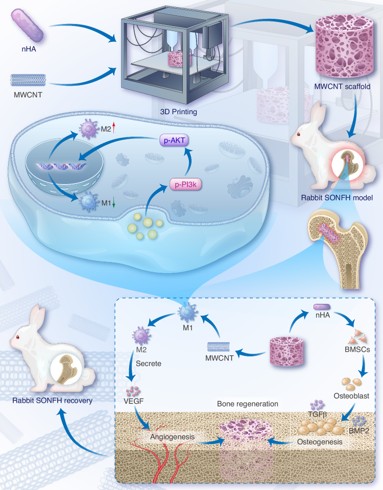

Researchers have developed a coral-inspired 3D-printed scaffold that reprograms immune cells to promote angiogenesis and bone regeneration
CHINA, August 13, 2026 /EINPresswire.com/ — Steroid-induced osteonecrosis of the femoral head (SONFH) can prevent damaged bone from healing, often leading to joint collapse and disability. Researchers have now developed a coral-inspired, 3D-printed scaffold that reprograms immune cells to create a healing environment for bone repair. In vitro and in vivo studies showed that the scaffold promoted angiogenesis and bone regeneration, offering a promising strategy for overcoming the disease’s underlying immune dysfunction and improving bone repair.
SONFH is one of the leading causes of non-traumatic osteonecrosis. Reported in up to 9%–40% of patients receiving prolonged or high-dose glucocorticoid therapy, the condition progressively weakens the femoral head and can eventually lead to joint collapse, making effective bone repair a major clinical challenge. Although core decompression is the standard treatment for early-stage disease, it cannot fully restore bone repair because persistent inflammation prevents the damaged tissue from healing.
To address this challenge, a research team led by Dr. Yan Xiong from the Department of Orthopaedics, Army Medical University (Third Military Medical University), China, Dr. Meng Tian from the Department of Neurosurgery and Neurosurgery Research Laboratory, Sichuan University, China, and Dr. Pengde Kang from the Department of Orthopedic, Sichuan University, China, reports a promising strategy focused on a coral-inspired, 3D-printed immunoreprogramming scaffold. They developed a scaffold made of multi-walled carbon nanotubes (MWCNT) and nano-hydroxyapatite (nHA) to enhance bone repair by reprogramming immune cells. The study was published in Volume 14 of the journal Bone Research on June 30, 2026.
“Current treatments mainly provide structural support but do not address the pathological immune microenvironment that prevents bone regeneration. Our coral-inspired immunoreprogramming strategy provides a new approach for targeting this microenvironment and promoting bone repair,” says Dr. Xiong.
One of the major obstacles to healing in SONFH is an “immune freeze”—a persistent inflammatory state in which macrophages, immune cells that normally coordinate tissue repair, remain locked in a pro-inflammatory (M1) state instead of transitioning to the tissue-repairing M2 state. As a result, inflammation persists, new blood vessel formation is impaired, and damaged bone struggles to regenerate even after surgical intervention. Inspired by the hierarchical pore structure of coral, the team developed a 3D-printed scaffold that combines the immune-regulating properties of MWCNT with the bone-like mineral characteristics of nHA. While the MWCNT component was designed to encourage macrophages to switch to the reparative M2 state, the nHA component provides a biomimetic mineral matrix that supports the attachment, growth, and differentiation of bone-forming cells. The researchers evaluated the scaffold using both in vitro cell-based experiments and in vivo rabbit models of SONFH.
Their findings showed that the scaffold successfully shifted macrophages from the inflammatory M1 state to the reparative M2 state, reducing inflammatory responses while creating a more favorable environment for healing. This immune reprogramming promoted the migration and osteogenic differentiation of bone marrow mesenchymal stem cells and enhanced angiogenesis, the formation of new blood vessels that supply oxygen and nutrients to regenerating tissue. Compared with conventional scaffolds, the coral-inspired scaffold also improved new bone formation and reconstruction of bone defects in the animal model.
Further analyses revealed that these effects were associated with activation of the PI3K-AKT signaling pathway, which regulates several cellular processes involved in tissue repair. By combining immune regulation with structural support, the scaffold addressed one of the key biological barriers that limit bone regeneration in SONFH, suggesting that modifying the local immune microenvironment may be just as important as repairing the bone itself.
“The coral-inspired immunoreprogramming technique proposed in this study provides a new strategy for targeting the regulation of the pathological microenvironment in SONFH. Although further studies are needed before clinical application, our findings provide a foundation for developing regenerative therapies that improve bone repair by restoring a pro-regenerative immune environment,” concludes Dr. Tian.
***
Reference
Title of original paper: Coral-inspired immunoreprogramming scaffold reverses the “immune-freeze” microenvironment to promote bone regeneration in steroid-induced osteonecrosis of the femoral head
Journal: Bone Research
DOI: 10.1038/s41413-026-00557-x
About Sichuan University, China
Sichuan University (SCU), located in Chengdu, China, is one of the country’s leading public research universities under the Ministry of Education. Formed through the merger of three prestigious institutions, SCU traces its origins to 1896, making it one of the oldest modern universities in Southwest China. The university is internationally recognized for excellence in education, research, and innovation across medicine, science, engineering, medicine, and the humanities. With four campuses and a strong emphasis on interdisciplinary research, SCU is committed to advancing scientific discovery and addressing global health and societal challenges.
Website: https://en.scu.edu.cn/
About Dr. Yan Xiong from Army Medical University, China
Dr. Yan Xiong is affiliated with the Department of Orthopaedics, Army Medical University, China. His research focuses on orthopedic surgery, hip and knee arthroplasty, enhanced recovery after surgery, diagnosis and treatment of orthopedic disorders, and musculoskeletal reconstruction. He has authored over 20 peer-reviewed publications and contributes to clinical and translational research aimed at improving orthopedic surgical techniques and patient outcomes.
About Dr. Meng Tian from Sichuan University, China
Dr. Meng Tian is affiliated with the Department of Neurosurgery and Neurosurgery Research Laboratory, Sichuan University, China. His research focuses on biomaterial science and its biomedical applications. He has authored 43 peer-reviewed publications with over 1,400 citations.
About Dr. Pengde Kang from Sichuan University, China
Dr. Pengde Kang is affiliated with the Department of Orthopedic, Sichuan University, Chengdu, China. His research focuses on osteonecrosis, bone regeneration, biomaterials, osteoimmunology, and hip and knee arthroplasty. He has authored 185 peer-reviewed publications with over 4,300 citations.
Funding information
This work was supported by the Sichuan Provincial Science and Technology Department youth project (2025ZNSFSC1789), Doctoral Research Launch Fund Project of North Sichuan Medical College Affiliated Hospital (CBY23 QDA23), and the Health Commission of Sichuan Province Medical Science and Technology Program (24QNMP096). This study was supported by the National Natural Science Foundation of China (Grant nos. 81974333, 82172414 and 81401528).
Yini Bao
Bone Research Editorial Office
+862885546461 ext.
br@scu.edu.cn
Visit us on social media:
X
Legal Disclaimer:
EIN Presswire provides this news content “as is” without warranty of any kind. We do not accept any responsibility or liability
for the accuracy, content, images, videos, licenses, completeness, legality, or reliability of the information contained in this
article. If you have any complaints or copyright issues related to this article, kindly contact the author above.

Media gallery