Dr. Mohana Rao Patibandla Highlights 92 Epilepsy Surgery Cases and the Role of Timely Pediatric Epilepsy Evaluation
Fellowship-trained epilepsy surgeon highlights the importance of timely evaluation for children with drug-resistant

Press Release Disclaimer: This is a press release distributed through the XPR Media network. It has not been independently verified by our newsroom.
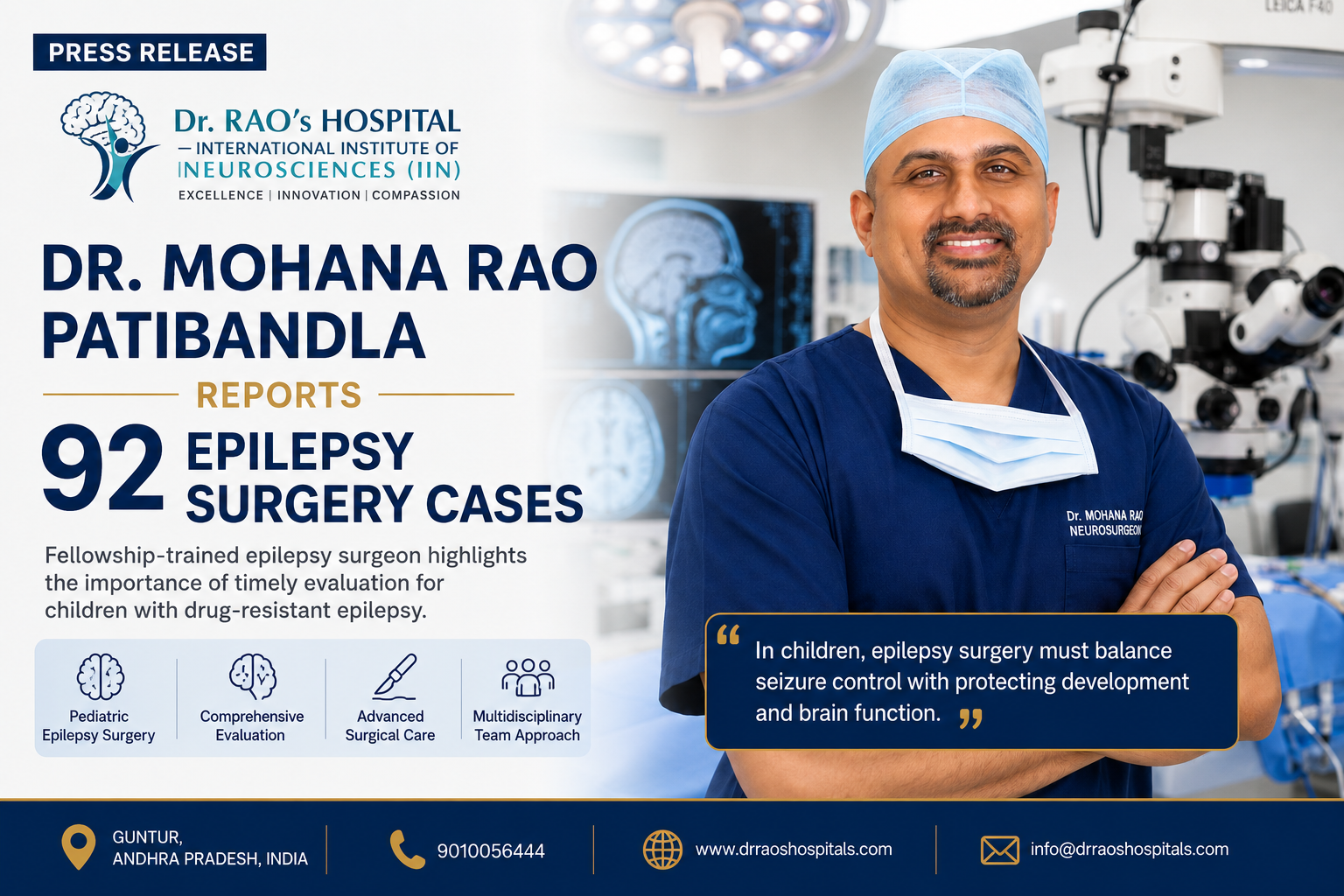

Fellowship-trained epilepsy surgeon highlights the importance of timely evaluation for children with drug-resistant epilepsy and improved quality of life.
GUNTUR, ANDHRA PRADESH, INDIA, August 19, 2026 /EINPresswire.com/ — When children continue to experience seizures despite appropriate anti-seizure medications, determining whether epilepsy surgery could provide a meaningful treatment option can become an important part of their care. Dr. Mohana Rao Patibandla, a fellowship-trained epilepsy surgeon and pediatric neurosurgeon, has performed 92 epilepsy surgery procedures as part of his clinical experience, including surgery involving pediatric epilepsy.
The experience highlights an important question for families of children with persistent seizures: When should a child with epilepsy be evaluated for possible surgery?
Why Pediatric Epilepsy Surgery Matters
Epilepsy is not a single disease, and seizures can arise from different regions or networks of the brain. Many children achieve seizure control with medication. However, some continue to experience seizures despite appropriate treatment. Such patients may have drug-resistant epilepsy and may benefit from assessment at a specialized epilepsy center.
Importantly, referral for epilepsy surgery evaluation does not mean that surgery is automatically recommended. A comprehensive evaluation is performed first to determine the cause and location of seizures, whether the epileptogenic region can be safely treated, and which treatment approach is most appropriate.
The International League Against Epilepsy recognizes epilepsy surgery evaluation as an important treatment pathway for appropriately selected patients with drug-resistant epilepsy, including children.
Who May Need an Epilepsy Surgery Evaluation?
A child may warrant referral to a specialized epilepsy surgery program when seizures continue despite appropriate medication trials, particularly when seizures are frequent or disabling, when epilepsy is associated with an identifiable structural brain abnormality, or when seizures are affecting development, learning, behavior or quality of life.
Early specialist assessment can be important because uncontrolled seizures during childhood may affect education and neurodevelopment. At the same time, every child requires individualized assessment because the potential benefits and risks of surgery vary according to the underlying epilepsy and the location of the seizure-producing brain tissue.
“Epilepsy surgery in a child is not simply a decision to remove a portion of the brain,” said Dr. Mohana Rao Patibandla. “The central question is whether we can accurately identify the seizure-producing region and treat it while preserving the functions that are essential for the child’s development, including movement, language, memory and cognition. That requires careful investigation and multidisciplinary decision-making.”
What Does the Evaluation Involve?
Presurgical evaluation is designed to establish where seizures originate and how that region relates to critical neurological functions.
Depending on the individual patient, investigations may include detailed seizure history and clinical assessment, prolonged video-EEG monitoring, high-resolution epilepsy-protocol MRI, functional imaging such as PET or SPECT, neuropsychological assessment, language and memory evaluation, and functional mapping when indicated.
In selected complex cases, invasive intracranial EEG monitoring may be required to further define the seizure-onset zone.
The purpose is to integrate the clinical history, EEG findings, imaging and functional information rather than relying on a single investigation.
What Types of Epilepsy Surgery Are Available?
There is no single epilepsy operation that is appropriate for every child.
Depending on the cause and location of epilepsy, treatment may involve resective surgery, disconnective surgery, minimally invasive ablative procedures or other surgical and neuromodulatory approaches in appropriately selected patients.
Some children may have a focal structural abnormality, such as focal cortical dysplasia or another lesion that can be identified through imaging. In other children, the seizure network may be more difficult to localize, requiring a substantially more detailed evaluation before treatment can be considered.
The decision must therefore be individualized and based on the balance between seizure control, neurological function, development and quality of life.
Dr. Rao’s Epilepsy Surgery Experience
Dr. Mohana Rao Patibandla is a neurosurgeon and founder of Dr. Rao’s Hospital – International Institute of Neurosciences (IIN), Guntur, Andhra Pradesh. He has undergone specialized fellowship training in epilepsy surgery and advanced training in multiple neurosurgical subspecialties, including pediatric neurosurgery, minimally invasive neurosurgery, skull base surgery, neuro-oncology, functional and stereotactic neurosurgery, and cerebrovascular and endovascular neurosurgery.
His reported experience includes 92 epilepsy surgery procedures, with clinical experience involving pediatric epilepsy surgery.
The case number represents cumulative surgical experience and should not be interpreted as a guaranteed outcome or as an indication that every patient is suitable for surgery. Epilepsy surgery outcomes depend on the underlying diagnosis, seizure localization, surgical strategy, neurological anatomy and individual patient factors.
When Should Parents Seek Specialist Advice?
Parents should consider specialist epilepsy evaluation when a child continues to have seizures despite appropriate treatment or when seizures are associated with developmental, cognitive, behavioral or educational concerns.
A surgical consultation can be useful even when the family is uncertain about surgery. The purpose of the evaluation is first to determine whether the child has drug-resistant epilepsy and whether a potentially beneficial surgical or other advanced treatment option exists.
“Parents should not assume that surgery is the next step simply because medications have not worked,” Dr. Rao added. “The first step is a comprehensive epilepsy evaluation. If surgery is appropriate, the objective is to select the safest and most effective treatment for that particular child.”
A Multidisciplinary Approach to Pediatric Epilepsy
Pediatric epilepsy surgery requires collaboration between specialists in epilepsy, neurology, neurosurgery, neuroradiology, neurophysiology, neuropsychology, anesthesia and critical care, depending on the patient’s needs.
Such collaboration is particularly important in children because treatment decisions must consider both immediate seizure control and the child’s long-term neurological and developmental future.
For families, the goal extends beyond reducing the number of seizures. Appropriate treatment may also seek to improve safety, school participation, development, independence and overall quality of life.
About Dr. Mohana Rao Patibandla
Dr. Mohana Rao Patibandla is a neurosurgeon, founder and Chief Neurosurgeon of Dr. Rao’s Hospital – International Institute of Neurosciences (IIN), Guntur, Andhra Pradesh, India.
He has advanced fellowship and international training across several areas of neurosurgery, including epilepsy surgery, pediatric neurosurgery, minimally invasive neurosurgery, skull base surgery, neuro-oncology, functional and stereotactic neurosurgery, and cerebrovascular and endovascular neurosurgery.
His clinical practice includes the evaluation and surgical management of complex neurological and neurosurgical conditions.
About Dr. Rao’s Hospital – International Institute of Neurosciences
Dr. Rao’s Hospital – International Institute of Neurosciences is a dedicated neuroscience hospital in Guntur, Andhra Pradesh, providing neurological, neurosurgical and spine care.
The hospital’s services include epilepsy and pediatric neurosurgery, brain and skull base surgery, cerebrovascular and endovascular neurosurgery, minimally invasive neurosurgery, spine surgery, neuro-oncology, stereotactic and functional neurosurgery, and neurocritical care.
For more information, visit Dr. Rao’s Hospital – International Institute of Neurosciences.
Media Contact:
Dr. Rao’s Hospital – International Institute of Neurosciences
12-19-67, Old Bank Road, Kothapet, Guntur, Andhra Pradesh, India
Phone: 9010056444
Email: info@drraoshospitals.com
Medical Disclaimer: This press release is intended for general educational and informational purposes and does not constitute individualized medical advice. Epilepsy surgery is not appropriate for every patient. Children with persistent seizures should undergo assessment by appropriately qualified epilepsy specialists, with treatment decisions based on individual clinical findings and multidisciplinary evaluation.
Mohana Rao Patibandla
Patibandla Narayana Swamy Neurosciences LLP
+ +91 90100 56444
info@drraoshospitals.com
Visit us on social media:
LinkedIn
Instagram
Facebook
YouTube
X
The best epilepsy surgery center in Guntur
Legal Disclaimer:
EIN Presswire provides this news content “as is” without warranty of any kind. We do not accept any responsibility or liability
for the accuracy, content, images, videos, licenses, completeness, legality, or reliability of the information contained in this
article. If you have any complaints or copyright issues related to this article, kindly contact the author above.

Media gallery